Friday, 20 January 2017

16th Jan 2016


14th / 15th January

The cold but dry weather on Sunday allowed me to strip the steering column and wiring from the dashboard which meant that the bulkhead was ready for removal.


Steering column and wiring loom now removed

On Sunday I removed the bulkhead and the body member that connects the two front outriggers and which form the bottom edge of the cab floor ( I am sure that they have a proper name!).
With the bulkhead out of the way I removed the front propshaft and unbolted the gearbox mounting bolts so the gear box and transfer boxes are now ready to be lifted out.

Gear box and transfer box ready for lifting out


The front of the chassis has been well protected by a coat of engine oil! 


Gear box markings


Friday, 13 January 2017

Christmas 2016


December 2016

Having bought the Land Rover as project vehicle with a view to rebuilding it as a reliable, capable and comfortable expedition vehicle my plan was to strip it back to a bare chassis and really start from scratch there as mechanical reliability and performance is for me more a priority than the aesthetics of the vehicle. So saying that I want a vehicle that is aesthetically pleasing and comfortable as well, but reliability and capability are my main concerns


Being home for three weeks over the Christmas period allowed me time to see what I had bought and to start stripping it back to a bare chassis. 

As I plan to document this project as it progresses probably the first thing to do is to give the Land Rover a name so without a great lot of thought the Land Rover is now referred to as "Wolfie". This is basically derived from the Wolf variant Land Rover developed for the MOD and not as my son thinks named after his cat which is called Wolfgang. 

Overall "Wolfie" looked to be in pretty decent shape. Despite the wording of the advert which when I bought it advised that the rear cross member needed replaced, the chassis appeared to be in pretty good condition. 

The bodywork was as envisaged, the ambulance body itself was in pretty good condition, with a broken hinge on the rear door and a couple of scrapes along the sides being the only real issues. The Land Rover itself was a different issue as the front wings and bonnet all showed signs of wear and tear and with the usual Land Rover dents caused by people standing on them. At this stage I think my plan is to repair the wings and potentially replace the bonnet, but I will see as the bodywork stage is far off in the future.

The cab doors were in a poor state. The drivers door had been repaired with an unsightly alloy plate pop riveted on to secure the upper and lower door halves - a really bodged job and not one that I could really envisage the military condoning. The passenger door was a bit better, although the bottom of the door was showing it's age a brand new upper window section had been fitted - really at odds with the bodged repair to the drivers doors. 

The bulkhead was as expected pretty rusty - repairable, but rusty. Having bought Wolfie knowing this I had already sourced a replacement from a 2015 Defender. This newer bulkhead does not have the opening vent panels, but as the Pulse has an additional ventilation system for the rear compartment I see this as a potential opportunity to do something different re ventilation.

Mechanically Wolfie was perhaps in better condition than I had hoped. Sold as having an engine that would not turn over I had prepared myself for it being seized. The engine however turned over easily by hand, but initially it looked as though someone had been trying to strip it or repair it prior to the auction as the alternator was hanging on its wires, the jubilee clips had been removed from most of the cooling hoses and the steering box was disconnected. Later investigation uncovered a number of new nuts fitted to engine mounts and auxiliary components while the exhaust manifold had only two bolts in it and the engine /gearbox bolts were either missing or were  of a variety different types. Who had been working on the engine and what they had been trying to do remains a mystery.

The one big issue with the engine was the lack of coollant. Whether this is because the engine had overheated and seized or whether it had been drained when the jubilee clips were removed I am unsure. Only a full strip down will reveal it's actual condition.

Given the overall condition of "Wolfie" my plan to strip it back to a bare chassis and rebuild her from there remained unchanged.

Body strip out and removal.

The strip out and removal of the stretcher carriers was a pretty straightforward affair as they are simply bolted into place. The only problem was that a number of the less accessible bolts were seized in place, but they were easily dispatched with the aid of a small angle grinder.

Only the MOD could afford a product engineered to the degree that the stretcher carriers were! Removing the stretcher carriers and associated fittings and supports considerably lightened the back of the Land Rover. As I have no use for the bits that were removed, I will list them on EBay in due course.


Ambulance stretcher racks prior to removal

Before starting to remove the body itself I removed the two fuel cam holders that are slung under it just behind the front outriggers. These came off pretty easily, but I had to drill out a few of the fixing screws as the heads had corroded away. 

I also removed the trim panels in front of the rear cross member. These practically fell off as they had obviously been battered about during Wolfie's earlier life and showed signs of numerous repairs. At this stage I removed the rear lights which are contained in alloy boxes fitted to the rear cross member.

The boxed were heavily oxidised and simply pulled off the cross member. The retaining bolts were in no state to undo. During the re build I will probably lift the lights and mount them on the new rear body panel that I am planning. This will move them out of the exposed underside area and protect them from weather and impact damage - again plans for the future!

Removing the body itself proved to be a bit more complicated. The body is held in place by 8 primary fixings through the chassis and approx 20 secondary fixings through the chassis outriggers. In addition the windscreen has to be either detached either at the top or bottom (I elected to detach it at the bottom). As well as physically disconnecting the body and chassis the wiring harness has to be split and the fuel filler disconnected.

The only real problem that I encountered was with the 8 primary fixing bolts connecting the body to the chassis. These have a tapered conical end with an internal hex head (Allen key) set into the floor of the body and a bolted head under the chassis. Unfortunately the bolts were rusted solid and the position of the bolt head meant that getting a long lever on to them was impossible, so I had no alternative but to drill and cut them out. Even with the heads drilled off I had to resort to a large hammer and punch to drive the bolts out of their holes.

Removing the conical fixing bolts in the ambulance body proved to be problematic!
Stripping out the cab was pretty straight forward with the angle grinder again being used to cut the numerous seized bolts


Exposing the chassis from above after removing the seat box

Removal of the dashboard exposed the rust damage to the bulkhead

The 300tdi engine

Rust had attacked the bulkhead just below the bonnet line

Stripping the front panels

Front bodywork removed


Winter in Scotland - not ideal conditions to work outside

I recently read a comment on a Land Rover forum where someone offered the opinion that there could not be much weight in a Pulse body - do not believe it! Even with the stretcher racks and fittings removed this is still seriously heavy!!

My initial plan was to jack the body up and slide it back on to a trailer. This was soon abandoned when I realised just how heavy the body actually was.

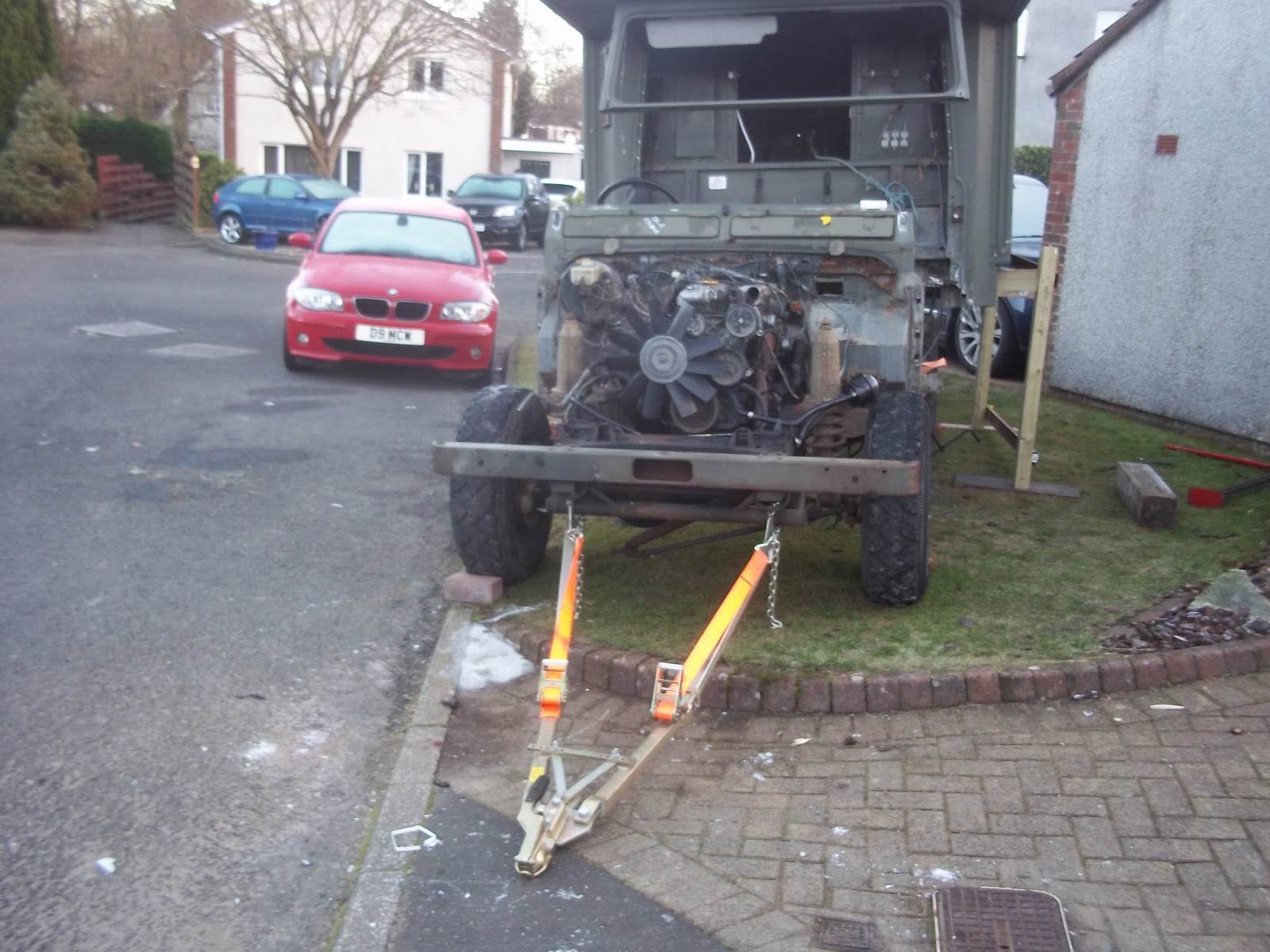
Plan "B" was to jack the body up and pull the chassis out from under the body while pulling the trailer under at the same time.

Overall things went OK, however with hindsight had I removed the riser pieces between the body and the front cross member from the body and not the chassis I would not have had to raise the body so high off the ground.


Checking to see if the body will lift

Tow frame fitted

Jacking the body off the chassis

The moment of truth

pulling the chassis out from under the ambulance body and pulling the trailer in to replace it
With the body removed the chassis was exposed. Despite a layer of surface rust and a lot of dirt the chassis overall was in surprisingly good condition.


The exposed chassis - much better condition than expected


With the body removed taking the engine out was pretty straightforward and justified the purchase of an engine crane (1/2 price on the Internet). The two ton crane effortlessly lifted the 300tdi unit off its mounts. On removal of the engine I discovered that there was a large hole in the gearbox bell housing. The hole through the alloy casting was obviously old as the edges had oxidised, but what had caused it?

Lifting out the engine

Parked in driveway awaiting bulkhead and running gear removal

Tuesday, 29 November 2016

Delivery

Earlier today the Land Rover was delivered having been collected from Withams yesterday. The haulier did comment that it was the first Land Rover that he had collected that had to be loaded on to his trailer with a forklift - that is probably not a good thing!

Unfortunately I will not see it until I get home in another 3 weeks time, but Kathleen was kind enough to take some photos of it's arrival.


Given that it was bought as a project it looks fine as far as I am concerned. If nothing else it will keep our neighbours something to speculate about for the next few weeks.


Wednesday, 23 November 2016

The Beginning - A Project is Born


24th November 2016


This Blog has been created to record our ownership of our Land Rover 130 (Wolf) which we purchased as a “project” vehicle in November 2016. The Land Rover is a Pulse ambulance. The body is a fourth generation ambulance body developed by Marshall Aviation in Cambridge. It is mounted on a military specification Land Rover Defender 130 – Wolf.

Showing her best side

The Land Rover Defender (Wolf) was the name given to the Military Only specification XD Defender (eXtra Duty) developed by Land Rover to fulfil the MOD’s requirement for a TUL / TUM (Transport Utility Light / Transport Utility Medium ) vehicle in 1986


So why have we bought a Land Rover?

Before going any further I should probably clarify “we”. It is probably best to read “I” instead of “we“ as Kathleen could quite easily live without another Project in our lives and allowed me to buy the Land Rover as my “hobby”.

Yet again I appreciate having such a tolerant wife who has let me do these things with little complaint. Although a reluctant participant in the "project", Kathleen will however enthusiastically  join me to travel in it once it is finished.

We have bought a Land Rover to convert it into an overland vehicle, which we can use to travel in when time allows.

Our current vehicle, a Toyota Landcruiser (our 5th Landcruiser) is a very capable vehicle, fast enough for motorway travel, more torque than you would ever need and fitted with our Maggiolina roof tent it forms a good base vehicle for overland travel. 

Despite all its pluses, it has a number of downsides however when it comes to overland travel. 

  • The lack of internal space means that all living is outside. Ideal when you are in the temperate of Africa or a warm climate such as found around the Mediterranean and in mainland Europe, but not so ideal if you are in wet, non-temperate Scotland. 
  • The vehicle size dictates that everything is carried in boxes, not a problem if you are travelling every day, but a bit of a pain if you are staying in one place for a week as you tend to want to get to things more regularly.· 
  • The vehicle size does restrict what you can take with you as there is not a lot of space for carrying water, fuel etc.
  • Toilet facilities are limited (non-existent)!

Ideally we wanted a larger vehicle, one that would not only be capable of going everywhere we wanted to go, but one that would address the few short comings of our Landcruiser. In a vehicle we were looking for:-

  • · Somewhere we could live and sleep in if the weather was cold or wet, 
  • · Increased and easily accessible storage, 
  • · Good off road capabilities
  • · Not too large as we wanted to be able to park it in towns and cities
  • · Not too expensive to run
  • · Easy to maintain with spare parts available throughout the world.
  • · The ability to lock it and leave it secure
  • · Strong build – i.e. it would not break
  • · A vehicle that we could adapt to suit our own requirements.
Choosing a vehicle

For the last 30 years or so I have driven Land Rovers and other 4 x 4 vehicles on the site roads associated with numerous large construction projects and on unmade roads in a number of third world countries. At one point I was a partner in a Land Rover hire business which ran a small fleet of Land Rover Defenders 90, 110, 30 and Discoveries, so I am well aware of their ruggedness and capabilities. Despite this exposure to Land Rovers my own preference has always been Toyotas as although arguably not as good off road as a Land Rover they still deal easily with most off road conditions and their on road performance is far superior to the basic Land Rover Defender. 

Unfortunately Toyota does not make the vehicle that ticked all our boxes and only after many months if not years of procrastination did I finally decide that the vehicle that we were looking for was a Land Rover Pulse. Having seen one still in use as an ambulance when we were in Namibia in 2015, it was obvious what potential the ambulance body offered for conversion.

As I have already mentioned the Defender (Wolf) on which the Pulse is built, is the basically an upgraded Land Rover Defender, developed by Land Rover to provide a much stronger and more reliable vehicle to meet the needs of the Military. The 300 tdi engine was retained in preference to the newer TD5 found in civilian Land Rovers of the same age as it was felt that the simpler 300 tdi without the more complex electronics of the TD5 would be easier to maintain in the field.

The Wolf also features a redesigned rear axle using stronger internals, hubs and outer casing, making it the strongest Land Rover axle ever.

The chassis was not galvanised partly to save cost and partly to alleviate health and safety concerns regarding the cyanide gas that is given off when galvanised steel is welded – this is a slightly spurious argument I would have thought as welding galvanised metal is not normally considered to be a big issue providing the metal is suitable prepared and H&S precautions taken i.e. do not breath in the fumes! The chassis on all Wolfs were however sprayed internally with Dinitrol rust proofing.

The chassis is considerably different in design to the standard Defender chassis even though it looks similar. The side walls are standard, most of the rest is bespoke. The additional rear load bed mounting was to take increased weights as the standard chassis kept punching big dents in the rear floor.

Having bought the Land Rover unseen on an MOD action site our purchase is perhaps a bit of a leap in to the unknown. The pictures that I have seen of it and the very brief description given about it highlights the fact that a lot of work is going to be required before it takes to the road again. On the plus side we own what must be one of the cheapest to buy Pulse Ambulances in civilian hands.

The work that can easily be identified from the listing photos includes:-

  • · Repairing or replacing the seized engine
  • · Replacing the rear cross member and dealing with any other chassis issues
  • · Replacing the missing windscreen
  • · Repairing / replacing both doors
  • · Repairing the steering that does not work
  • · Sorting the obvious body issues
  • · Dealing with whatever water damage has been caused due to the windscreen being missing.
  • · Repairing or replacing the bulkhead

Of course there will be numerous other jobs to be tackled and I am under no illusion that this will be a quick fix up and go. On the bright side however we have a blank canvas and over the next two years hopefully we can build a pretty decent overland vehicle.


I have arranged for the Land Rover to be collected from its current location just north of London on the 28th of November and delivered to our house the next day. Frustratingly I will not see the Land Rover until Christmas as I am currently working overseas and I am not home again until then. Hopefully Kathleen will manage to take a few more pictures when it is delivered next week.

What a big behind!


Missing a windscreen


Interesting door repair

Steering linkage disconnected.

At least it has some steps!

Complete interior will be removed - to be listed on Ebay!

There will be a lot of usable space once emptied of ambulance fittings


Tin worm on rear cross member


Front Bulkhead has seen better days


Signs that the windscreen has been missing for a while


Interior refurbishment required


One seized 300 tdi engine and one rusty bulkhead